Prostate Symptom Test (IPSS) and a PSA Value Interpreter
A weak stream, getting up at night, the feeling that the bladder is not empty: every second man over fifty has urinary complaints, and most do not report them to a doctor for years. The IPSS (International Prostate Symptom Score) is the questionnaire urologists worldwide use to measure how severe those complaints are and to follow whether treatment works. Answer eight questions and see at once whether the complaints are mild, moderate or severe and what follows in each case. Below is also a PSA interpreter by age, because those two results are always read together.
IPSS prostate symptom test
Answer all 8 questions for the past month.
The result is an informative estimate and does not replace an examination and a doctor's interpretation.
Why the prostate causes urinary complaints
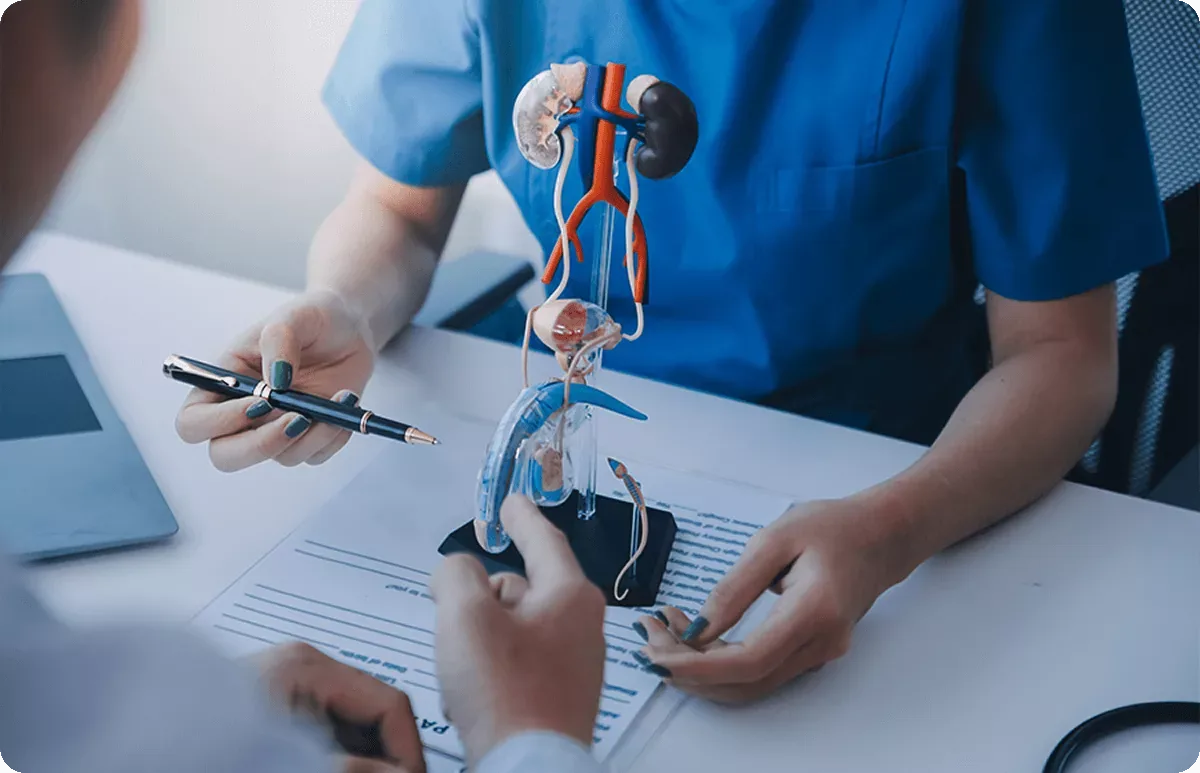
The prostate surrounds the first part of the urethra, just below the bladder. From the forties on it slowly grows in most men (benign prostatic hyperplasia), narrows the urethra and the bladder has to work harder: the stream weakens, urination is delayed and interrupted, the bladder does not empty fully, so you urinate more often and at night. The growth is benign and unrelated to cancer, but the complaints worsen with time, and untreated urinary retention damages the bladder and kidneys.
The same complaints can be caused by prostate inflammation, a urethral stricture, an overactive bladder, some medicines and diabetes, so the IPSS measures the severity of the complaints while the urologist establishes the cause with an examination and ultrasound. Read more about PSA values and what a raised result means in PSA: values by age.
How the IPSS score is read
| Score | Severity | What usually follows |
|---|---|---|
| 0 to 7 | mild | follow-up, advice, yearly examination after 50 |
| 8 to 19 | moderate | urology examination, ultrasound, PSA, usually medicines |
| 20 to 35 | severe | urology examination in the coming weeks, medicines or a procedure |
PSA value interpreter
PSA (prostate-specific antigen) is a protein secreted by the prostate that is found in small amounts in the blood. It rises with age and with the size of the prostate, which is why it is interpreted by age rather than by a single limit. A raised PSA most often does not mean cancer: two out of three men with a PSA between 4 and 10 do not have prostate cancer. That is why the urologist looks at the free-to-total PSA ratio, the rate of rise against previous results, the size of the prostate on ultrasound and the digital rectal examination alongside the PSA.
Enter your age and the total PSA value from your report.
Age-specific upper limits are indicative; laboratories often print a single limit of 4 ng/mL. PSA is not taken during an infection, within 48 hours of ejaculation or cycling, or within a week of a prostate examination.
When to see a urologist
At the Miren Medic polyclinic a urology examination with an ultrasound of the prostate, bladder and kidneys is done in one appointment, without a referral, and PSA and urine in our laboratory. Book an examination if:
- the IPSS score is 8 or more, or you get up at night two or more times
- PSA is above the limit for your age, or has risen by more than 0.75 ng/mL in a year
- you have blood in the urine or semen, pain in the flank or perineum, or recurrent infections
- you cannot urinate or the bladder stays full: that is an emergency
- you are 50 (45 with prostate cancer in the family) and have never seen a urologist: the first preventive examination
Examination prices
| Service | Price |
|---|---|
| Urologist consultation (Dr Aleksandar Lazić) | 6.000 RSD |
| Urological ultrasound | 6.000 RSD |
| Consultation + ultrasound | 10.000 RSD |
Frequently asked questions
What is the IPSS?
The International Prostate Symptom Score: seven questions about urination over the past month, each scored 0 to 5, and one question about quality of life. A total of 0 to 7 means mild, 8 to 19 moderate and 20 to 35 severe complaints. It is used for assessment and for following treatment.
What is a normal PSA value by age?
Indicative upper limits are 2.5 ng/mL up to 49, 3.5 up to 59, 4.5 up to 69 and 6.5 ng/mL after 70. Many laboratories print a single limit of 4 ng/mL. The value is always interpreted with age, prostate size and previous results.
Does a raised PSA mean prostate cancer?
Most often not. PSA also rises with an enlarged prostate, inflammation, after ejaculation, cycling and an examination. Of men with a PSA between 4 and 10 ng/mL about two thirds do not have cancer. The urologist repeats the test, looks at the free-to-total ratio and does an ultrasound, and when needed an MRI and biopsy.
How to prepare for a PSA test?
No ejaculation or cycling for 48 hours before the blood draw, not during a urinary infection and at least a week after a prostate examination or catheterisation. Fasting is not required, but PSA is usually done with the other tests in the morning.
Does an enlarged prostate have to be operated on?
Rarely. Most men with moderate complaints respond well to medicines that relax or shrink the prostate. A procedure is considered for severe complaints that do not respond to medicines, urinary retention, recurrent infections, bladder stones or kidney damage.