Is a Mole Dangerous? The ABCDE Mole Self-Check and When to Book a Dermoscopy
Everyone has moles and almost every one is harmless; the problem is that the one that is not does not stand out by hurting, but by how it looks and how it changes. The ABCDE rule is the simple way both dermatologists and patients look at a mole: asymmetry, border, colour, diameter and evolution. Go through the list below for the mole that worries you, add the warning signs and your risk factors, and see at once whether a yearly check is enough, whether it is time for a dermoscopy, or whether that should not be put off.
ABCDE mole self-check
Tick everything that applies to the mole that worries you and to you, then click "Assess".
The result is an informative estimate and does not replace an examination and a doctor's interpretation.
What the ABCDE rule really means
A harmless mole is usually symmetrical, with a sharp border, one colour and smaller than 6 mm, and looks the same for years. Melanoma, the most dangerous skin cancer, breaks those rules: it grows unevenly and becomes asymmetrical, its border blurs, different colours appear in it because the cells grow unevenly, it passes 6 mm and, most importantly, it changes. The letter E is the most important of the five: a mole that has been stable for years is almost never a melanoma, and one that has been changing for months should be looked at even when A, B, C and D are fine.
The rule does not cover everything: a melanoma can be small and one-coloured, and the nodular form is especially deceptive, growing in height, often pink or red, which is why ABCDE misses it. That is why two more signs are used with the rule: the ugly duckling (a mole that stands out from all the others on the body) and a new mole after 40, because new moles normally stop appearing after 30 to 35.
What dermoscopy is and why it replaces guessing
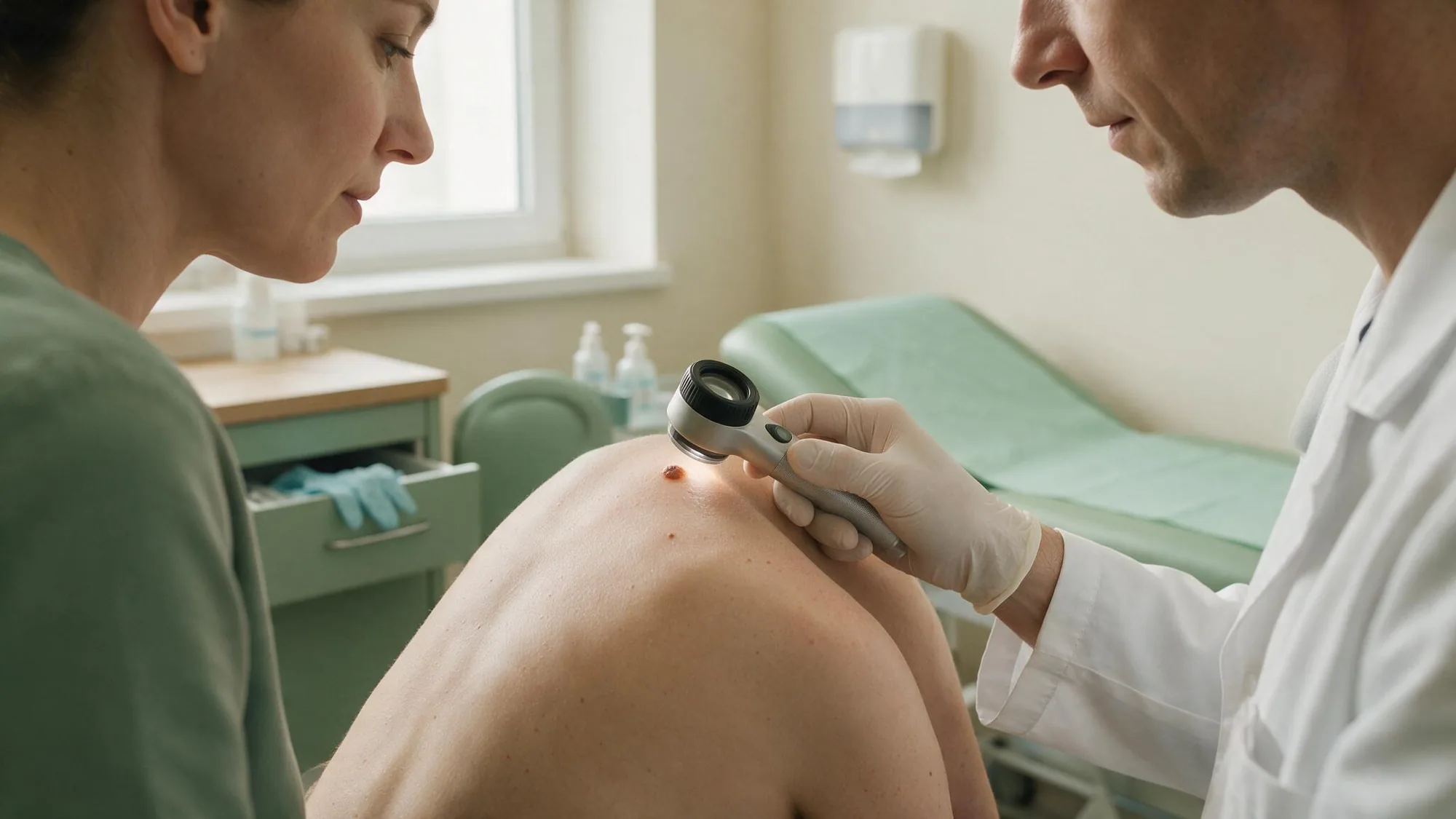
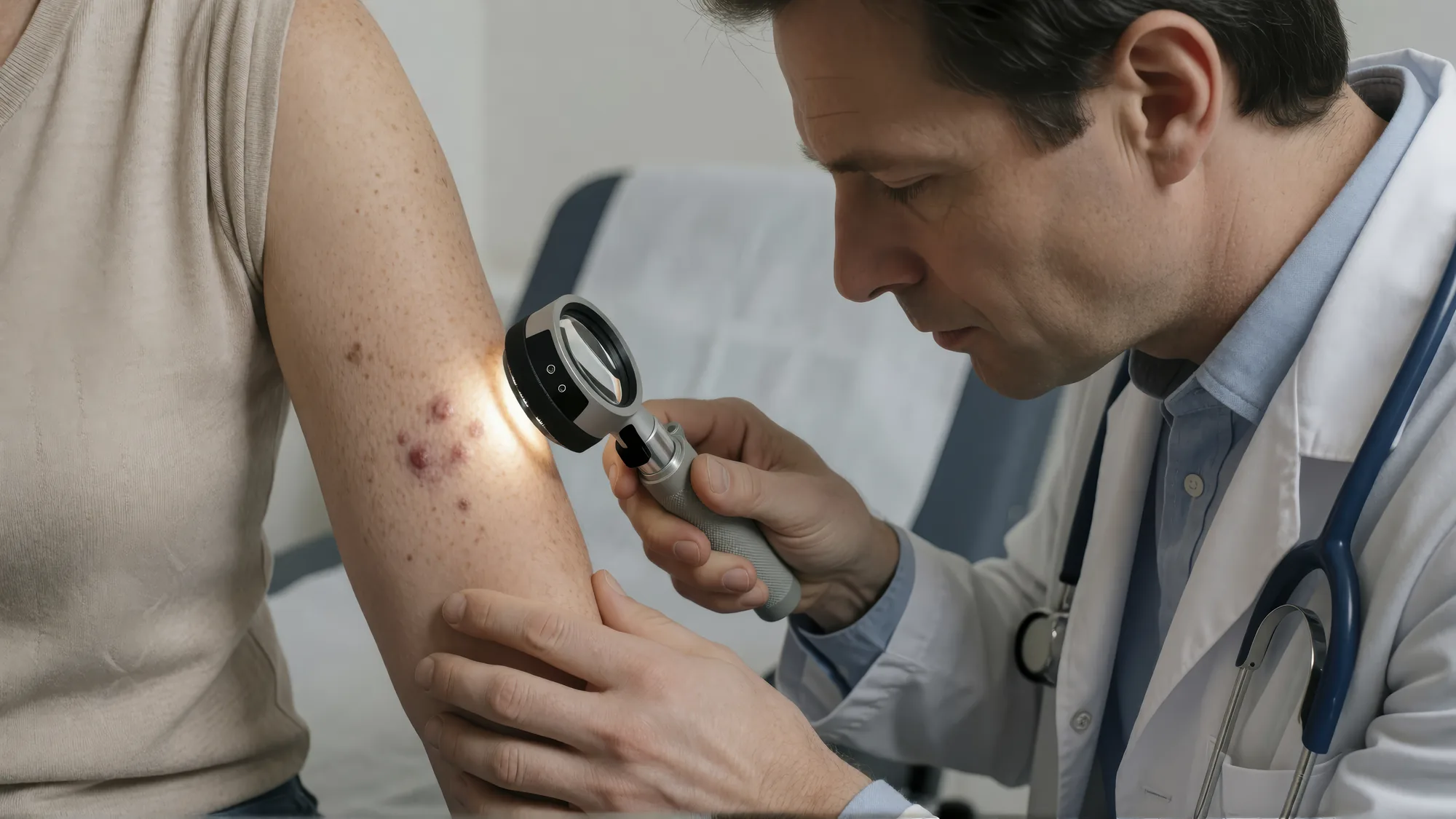
A dermatoscope is a hand-held device that magnifies the mole 10 times under polarised light and shows the structures below the skin surface: the pigment network, dots, globules, blood vessels. Neither you nor the doctor can see those structures by eye, and they are exactly what tells a harmless mole from a suspicious one. A dermoscopy examination at the Miren Medic polyclinic takes 15 to 20 minutes, is painless and needs no preparation. When a mole is suspicious it is removed whole and sent for histopathology, which is the only certain answer. Read about the examination in detail on the mole check page.
For moles that are not suspicious but bother you (shaving, rubbing clothes, appearance) the dermatologist chooses between radiofrequency and surgical removal; every removed mole goes to histopathology without exception. Read our article on the ABCDE rule and self-examination too.
How to do a self-check at home
- once every 3 months, in a well-lit room, with a mirror and ideally with a household member's help for the back, the nape and the back of the legs
- check the places the sun does not see too: the soles, between the toes, under the nails, the scalp, the genitals
- photograph the moles that worry you next to a ruler or a coin, with the date; change is easiest to see by comparison
- pay special attention to the back in men and the lower legs in women, where melanoma most often arises
- sun protection (SPF 30 and above, shade between 11 and 16 h, no sunbeds) is the only known prevention
When to have an examination without delay
- a mole that has changed in the last few months, by any of the five letters
- a mole that bleeds, itches, hurts or has a sore that has not healed for more than 3 weeks
- a dark streak under a nail that is spreading, or a new dark mole on the palm or sole
- a pink or red nodule that grows quickly, even without pigment
- a previous melanoma in you or in the family and any new mole
Examination prices
| Service | Price |
|---|---|
| Dermoscopy | 6.000 RSD |
| Dermatologist consultation | 7.000 RSD |
| Radiofrequency removal of skin lesions (keratoses, small capillaries, hemangiomas, fibromas, cysts, xanthelasma, papillomas) | 3.000 to 20.000 RSD |
Frequently asked questions
How do I know whether a mole is dangerous?
By the ABCDE rule: asymmetry, irregular border, several colours, a diameter over 6 mm and, most importantly, change over months. Warning signs on top are itching, bleeding, a sore that does not heal and a mole that stands out from the others. It is reliably established only by a dermoscopy examination with a dermatologist.
What is dermoscopy and does it hurt?
An examination of moles with a hand-held magnifying device under polarised light that shows the structures below the skin surface. It does not hurt, needs no preparation and takes 15 to 20 minutes for all the moles on the body. At the Miren Medic polyclinic it is done without a referral.
How often should moles be checked?
A self-check at home every 3 months, a dermoscopy examination once a year if you have more than 50 moles, fair skin, childhood sunburns or melanoma in the family. Without risk factors an examination when a mole changes is enough.
Can a mole be removed and how?
Yes, suspicious moles are removed surgically as a whole, and harmless ones that bother you by radiofrequency or surgery. Every removed mole is sent for histopathology. Laser removal without a prior dermoscopy is not recommended, because it destroys the tissue that should be analysed.
Does a new mole after 40 always mean something bad?
Not always, but it needs an examination: new moles normally stop appearing between 30 and 35, so every new pigmented lesion after 40 is checked by dermoscopy, especially if it grows or stands out from the others.