Mole Check: The ABCDE Rule and What a Dermatoscope Sees
After summer, moles look different: they darken, and sometimes a new one appears. Most of those changes are harmless, but the end of summer is exactly when the ones that are not are easiest to spot. This article explains the ABCDE rule you can use to check a mole yourself, what a dermatoscope sees that the naked eye cannot, and when an examination should not be postponed.
The ABCDE rule
Five letters, five features to look at. None of them alone means melanoma, but each is a reason to have the mole seen by a dermatologist.
| Letter | Feature | What it looks for |
|---|---|---|
| A | Asymmetry | Imagine halving the mole: the two halves do not match. |
| B | Border | Edges are notched, blurred or ill defined rather than smooth and regular. |
| C | Colour | Several shades within the same mole: brown, black, red, white or bluish. |
| D | Diameter | Wider than about 6 mm, roughly the size of a pencil eraser. |
| E | Evolution, change | Any change in size, shape, colour or sensation over time. |
Alongside ABCDE there is the ugly duckling rule: within one person moles usually resemble one another, so the one that clearly stands out from the rest deserves attention even when it satisfies every other criterion. Dermatologists use it in practice as often as ABCDE.
When not to wait
- the mole has started to bleed, weep or fails to heal;
- it itches, stings or hurts;
- it has grown or changed colour rapidly over a few months;
- a new dark mole has appeared after the age of 40;
- the lesion is on a sole, palm, under a nail or on a mucous membrane;
- there is melanoma in the family, or you have more than fifty moles, fair skin and a history of sunburn.
The reason for urgency is simple: a melanoma found while it is still superficial is treated by straightforward excision and has an excellent prognosis. The same lesion a year later can be an entirely different story. Delay here does not cost money, it costs outcome.
What a dermatoscope sees and the eye does not
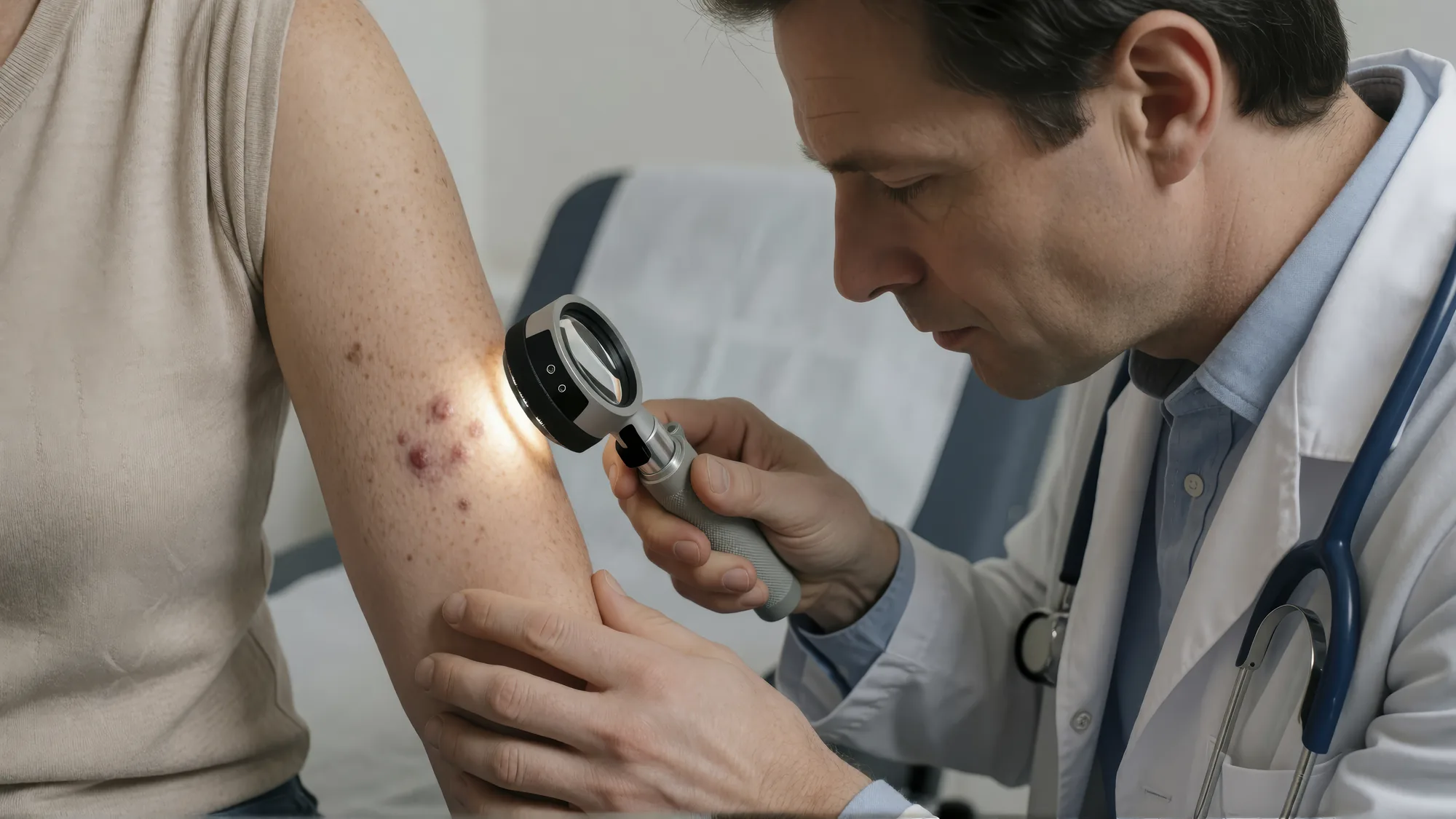
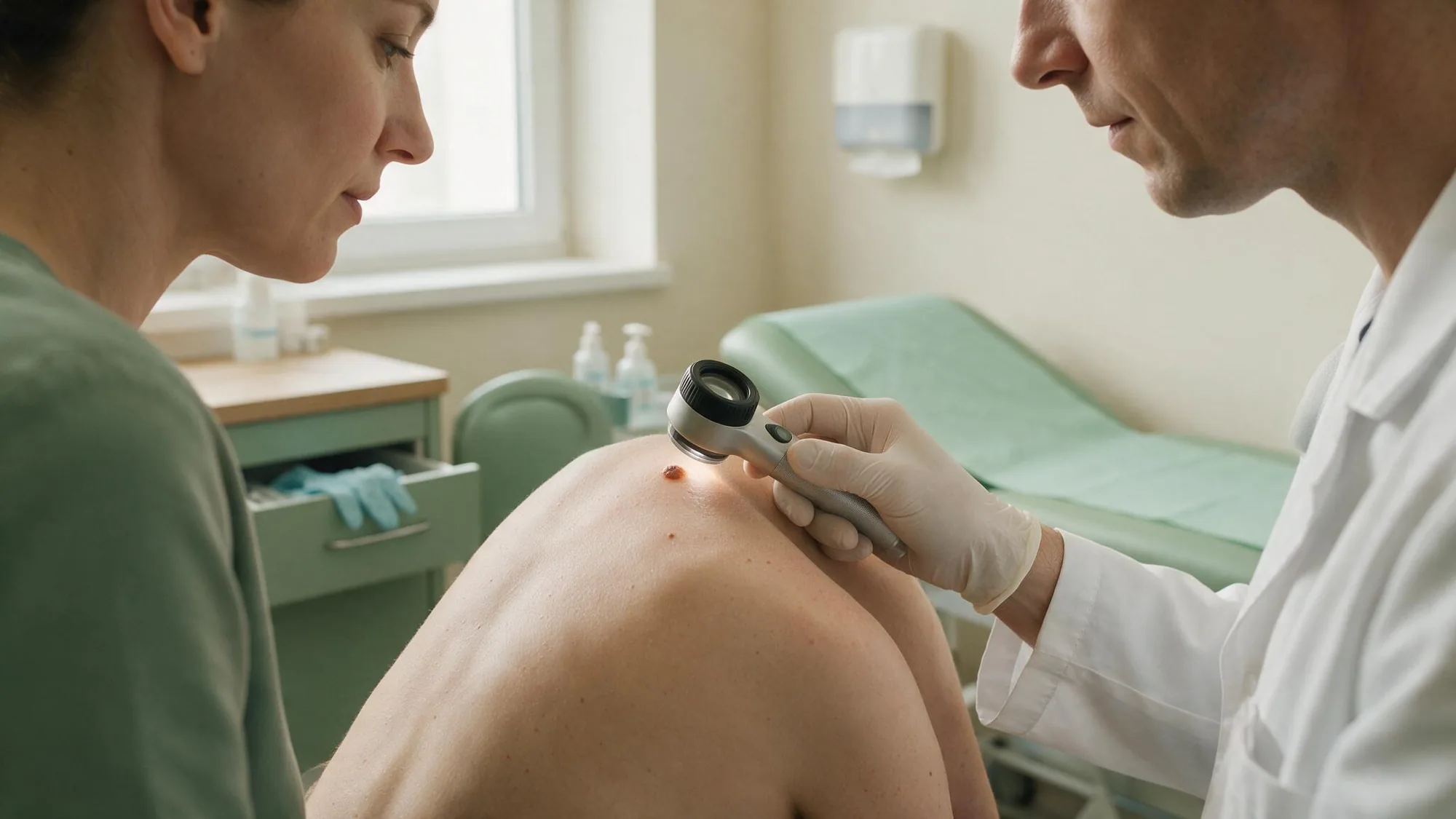
Dermoscopy is an examination of the mole with a handheld device that magnifies the lesion and, using polarised light, removes the reflection from the skin surface. That lets the dermatologist see structures below the surface: the distribution of pigment, the network, dots, blood vessels and the symmetry of the pattern. Those details are simply not visible to the naked eye.
The practical benefit runs both ways. Dermoscopy detects suspicious lesions that look harmless from the outside, and it also confirms that an alarming looking lesion is in fact an ordinary seborrhoeic keratosis or a benign mole. That spares a large number of unnecessary excisions.
The examination itself is painless and requires no preparation, no anaesthesia and no recovery. Coming without make-up, nail polish and self-tanner makes assessment easier, and moles should not be covered with a plaster before the appointment.
What the examination involves here
The appointment begins with a conversation about what brought you in and whether you have noticed a change. The skin is then examined, and suspicious lesions are assessed separately with the dermatoscope. At the end you get a clear answer: the mole is fine and simply watched, watched over a defined interval, or removed.
If a lesion is removed, radiowave removal is available for benign lesions and surgical excision with histopathology when confirmation of the diagnosis is needed. The doctor chooses the method from the findings, not from a wish to simply have the lesion taken off: any suspicious lesion must go for analysis. More about the service on the mole check page, and about the department on the dermatology page.
How often to come for a check
For an adult with no risk factors, once a year is enough, and the most natural time is late summer or early autumn, when sun-related changes are most visible. If you have many moles, fair skin, melanoma in the family or a previously removed suspicious lesion, the dermatologist sets a shorter interval, most often six months.
Between appointments one simple habit helps: once a month look over your skin, including your back with a mirror or a family member's help, the soles, between the toes and the scalp. A phone photograph next to an object for scale makes comparison over time easier, and that is information a dermatologist genuinely uses.
Prices
| Service | Price |
|---|---|
| Dermatoscopy | 6.000 RSD |
| Dermatology consultation | 6.000 to 7.000 RSD |
| Radiowave removal of skin lesions | 3.000 to 20.000 RSD |
| Surgical removal of lesions | 14.000 to 25.000 RSD |
| Histopathology | 6.000 to 8.000 RSD |
Check it now
- Is a mole dangerous?: the ABCDE self-check with warning signs and an urgency estimate.
Frequently asked questions
What is the ABCDE rule for moles?
It is five features by which a mole is assessed: asymmetry, irregular borders, several colours within one lesion, a diameter greater than about 6 mm, and change over time. The last letter matters most, because change over time is a stronger signal than appearance at a single moment.
What is dermoscopy and does it hurt?
Dermoscopy is an examination of a mole with a handheld device that magnifies the lesion and removes surface reflection, so the dermatologist can see structures below the surface. The examination is entirely painless, needs no preparation or anaesthesia, and takes a few minutes.
How much does a mole check cost?
Dermatoscopy at Miren Medic costs 6.000 RSD and a dermatology consultation 6.000 to 7.000 RSD. If a lesion is removed, radiowave removal is 3.000 to 20.000 RSD depending on the lesion, and surgical removal 14.000 to 25.000 RSD.
How often should moles be checked?
For adults with no risk factors, once a year, ideally in late summer or early autumn. With a large number of moles, fair skin, melanoma in the family or a previously removed suspicious lesion, the dermatologist sets a shorter interval, most often six months.
Is it dangerous to remove moles?
It is not, when a doctor does it and the method is chosen from the findings. What is dangerous is something else: removing a suspicious lesion without histopathology, because that loses the chance to establish the correct diagnosis. This is why every suspicious lesion is excised surgically and sent for analysis.
Book a consultation
If you have noticed a new mole after summer, or a change in an existing one, book an appointment at Miren Medic. The dermatology consultation and dermoscopy are done in the same appointment, and you get the answer and the proposed next steps straight away.