How to Remove Dark Spots on the Face: Which Treatment for Which Type
There is no single answer to how dark spots are removed from the face, because there is no single kind of spot. A sun spot and melasma look alike to a layperson and call for opposite approaches: the first comes off with a laser quickly and for good, the second often gets worse from a strong laser. That is why almost every story along the lines of "the laser cleared my spots and they were back in three months" comes down to melasma treated as though it were a sun spot. This article sorts the types, what works for each, how many sessions it takes, what it costs and what must never be treated before an examination.
The type is established first, the treatment second
| Type | How it looks and where | What usually helps |
|---|---|---|
| Sun and age spots | Sharply defined, light to dark brown, on the cheekbones, forehead, chest and backs of the hands. After years of sun. | The most rewarding for laser. Picosecond or IPL treatment, often 1 to 3 sessions. |
| Melasma | Symmetrical patches with blurred edges on the cheeks, forehead and above the lip. Mostly in women, worse in summer and in pregnancy. | Never an aggressive laser first. Strict sun protection, topical treatment prescribed by a dermatologist, gentle protocols. |
| Post-inflammatory marks | Wherever acne, an injury or a treatment has been, following the shape of that lesion. More common and more stubborn on darker skin. | Settle the cause of the inflammation first. Then time, topical treatment and mild procedures. |
| Freckles | Small, light, numerous, darker in summer and faded in winter. Genetic, usually since childhood. | A cosmetic choice, not a disease. Easily removed, but they return with the sun. |
| A lesion that is new or changing | Growing, changing colour or shape, irregular edges, sometimes itching or bleeding. | No aesthetic treatment at all. Dermoscopy first. |
There is also a practical difference you can notice yourself. Sun spots stay in one place for years and do not change much with the seasons. Melasma breathes with the sun and with hormones: it darkens in summer, fades in winter, and after childbirth or a change of contraception it can appear or disappear on its own.
Why melasma comes back
Melasma is not a stain in the skin that can be wiped away. It is a pigment-producing cell that has become hypersensitive to sun, heat and hormones. Treatment calms it down but does not change it, so the pigment returns as soon as the trigger does. For melasma, therefore, the goal is not framed as removal but as keeping it under control, with periods when the skin is almost even and periods when it needs maintenance.
This is also where the most expensive mistake in the whole field lives. A strong ablative or heat-based treatment in melasma can provoke a rebound and leave the condition worse than before, sometimes permanently. So a serious melasma plan starts with protection and topical treatment, and a device comes later, at lower settings and with the skin phototype taken into account.
What each treatment does
- PicoWay picosecond laser. Breaks pigment up with extremely short pulses and less heat than older lasers. First choice for sun and age spots, and with careful settings for melasma too.
- Lumecca IPL. Works over a wider field and catches pigment and fine red vessels at the same time, so it is the logical choice when the face is uneven in both colour and redness.
- Topical treatment. Creams prescribed by a dermatologist slow pigment production. In melasma these are not an add-on but the foundation, and they only work alongside consistent sun protection.
- Peels and microneedling protocols. They speed up renewal of the surface layers and help with post-inflammatory marks, once the inflammation has settled.
- Fractional CO2 laser. Works on texture and skin renewal, and is chosen when scars or wrinkles accompany the pigment, rather than as a first move against a spot itself.
How many sessions, and when the result shows
| Type of spot | Sessions, roughly | When it shows | Does it come back |
|---|---|---|---|
| Sun and age spots | 1 to 3 | The spot darkens, then flakes off over 7 to 14 days | Not that one, but new ones form without protection |
| Melasma | Maintenance, not a course | Gradually over 2 to 3 months | Yes, when sun or a hormonal trigger returns |
| Post-inflammatory | Often without a device at all | 3 to 12 months, patience needed even with treatment | Only if the inflammation recurs |
| Freckles | 1 to 2 | Over 7 to 14 days | Yes, every summer |
One thing confuses patients after the first session: the spot goes darker than it was. That is expected. The broken-up pigment moves toward the surface and only then flakes away, so the result is judged after two weeks, not after two days.
Sun protection is part of the treatment, not an extra
Without this, money spent on a laser is simply thrown away. The pigment cell reacts to light and is more sensitive after treatment than usual, so one careless weekend at the seaside can undo three sessions.
- Factor 50, every day, in winter and under cloud too, because the radiation that makes pigment passes through cloud and glass.
- Reapply every two to three hours when you are outdoors. One morning application does not cover a whole day.
- Tinted protection for melasma. Melasma is also driven by visible light, which a plain transparent product does not block and a tinted one with mineral pigments does.
- A hat and shade in the middle of the day. The cheapest measure on the list and the only one that works without a reminder.
- Mind the heat. In melasma, saunas, ovens and long drives in the sun can set the pigment off independently of any tan.
When a spot is not a spot
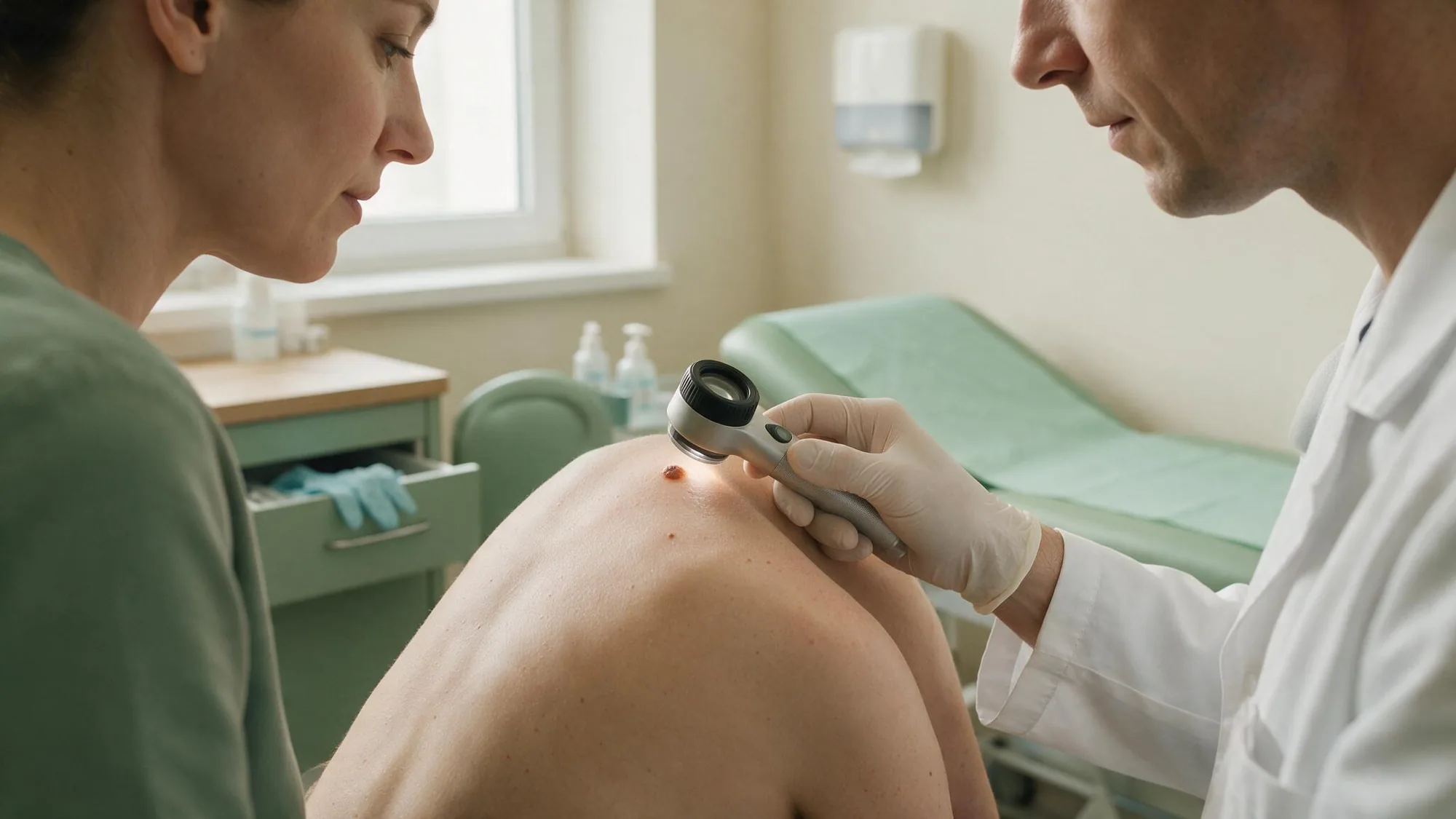
This part is not skipped. A lesion that is new after forty, that grows, changes colour or shape, has irregular edges, itches or bleeds does not go to any aesthetic treatment until a dermatologist has looked at it with a dermatoscope. A laser removes visible pigment and can therefore hide a lesion that should have been diagnosed rather than covered over.
How lesions are assessed, and what a dermatoscope sees that the naked eye cannot, is explained in mole check and the ABCDE rule. If your main question is where facial pigmentation comes from in the first place, there is also the article on the causes of hyperpigmentation.
Prices
| Service | Price |
|---|---|
| Dermatology consultation | 6.000 to 7.000 RSD |
| Dermatoscopy | 6.000 RSD |
| Skin diagnostics with the Skin Instant Lab device | 3.000 RSD |
| Laser removal of pigmentation | 18.000 to 36.000 RSD |
| Lumecca laser | 24.000 RSD |
| PicoWay laser treatment | 12.000 to 96.000 RSD |
| CO2 laser for the face | 54.000 RSD |
Consultations are booked without a referral and are carried out by the dermatologists at Miren Medic. There is more about the department on the dermatologist Belgrade page.
Frequently asked questions
How are dark spots removed from the face?
It depends on the type. Sun and age spots respond best to a picosecond laser or IPL, usually in one to three sessions. Melasma is not removed by laser but kept under control, with sun protection and topical treatment. Post-inflammatory marks after acne usually fade on their own, with protection and patience. That is why the type is established at the consultation first.
How much does removing facial spots cost?
At Miren Medic, laser removal of pigmentation is 18.000 to 36.000 RSD, Lumecca laser is 24.000 RSD and PicoWay treatment is 12.000 to 96.000 RSD depending on the size of the area. A dermatology consultation is 6.000 to 7.000 RSD and dermatoscopy is 6.000 RSD. The final price is confirmed at the consultation, once the type of spot and the number of sessions are known.
Do spots come back after laser?
A sun spot that has been removed does not usually return, but without sun protection new ones form elsewhere. Melasma comes back for most people, because sun, heat and hormones drive it, so it is managed as a condition that needs maintenance. Freckles return every summer.
Why is the spot darker after treatment?
That is the expected course. The broken-up pigment moves toward the surface of the skin, so the spot darkens first and only then flakes away, usually over seven to fourteen days. The result is therefore judged after two weeks. The crust is not picked off and the area is kept out of the sun until the skin has renewed.
Can laser make melasma worse?
It can, and it is the most common mistake in this field. A strong heat-based or ablative treatment in melasma can provoke a rebound and leave the pigment more pronounced than before. This is why melasma starts with sun protection and topical treatment, and a device is introduced later, at lower settings and with the skin phototype assessed.
Can spots be treated in summer?
Treating tanned skin carries a higher risk of an unwanted colour change, so treatment is usually planned for a time when the skin is not exposed to strong sun and you can protect it for several weeks. If you are going to the coast, treatment is postponed. The dermatologist makes that judgement at the consultation, based on phototype and the state of the skin.
When does a facial spot need a doctor rather than a treatment?
When it is new after the age of forty, when it grows or changes colour and shape, when its edges are irregular, when it itches or bleeds, or when it looks different from every other lesion on your skin. In those cases dermoscopy comes first, and no aesthetic treatment is performed until the lesion has been assessed.
Book a consultation
If you have spots on your face and do not know what type they are, book a dermatology consultation at Miren Medic. One appointment gives you an assessment of the type, a treatment plan suited to that specific type and an exact price, with no referral.